 Hanoi City Guide
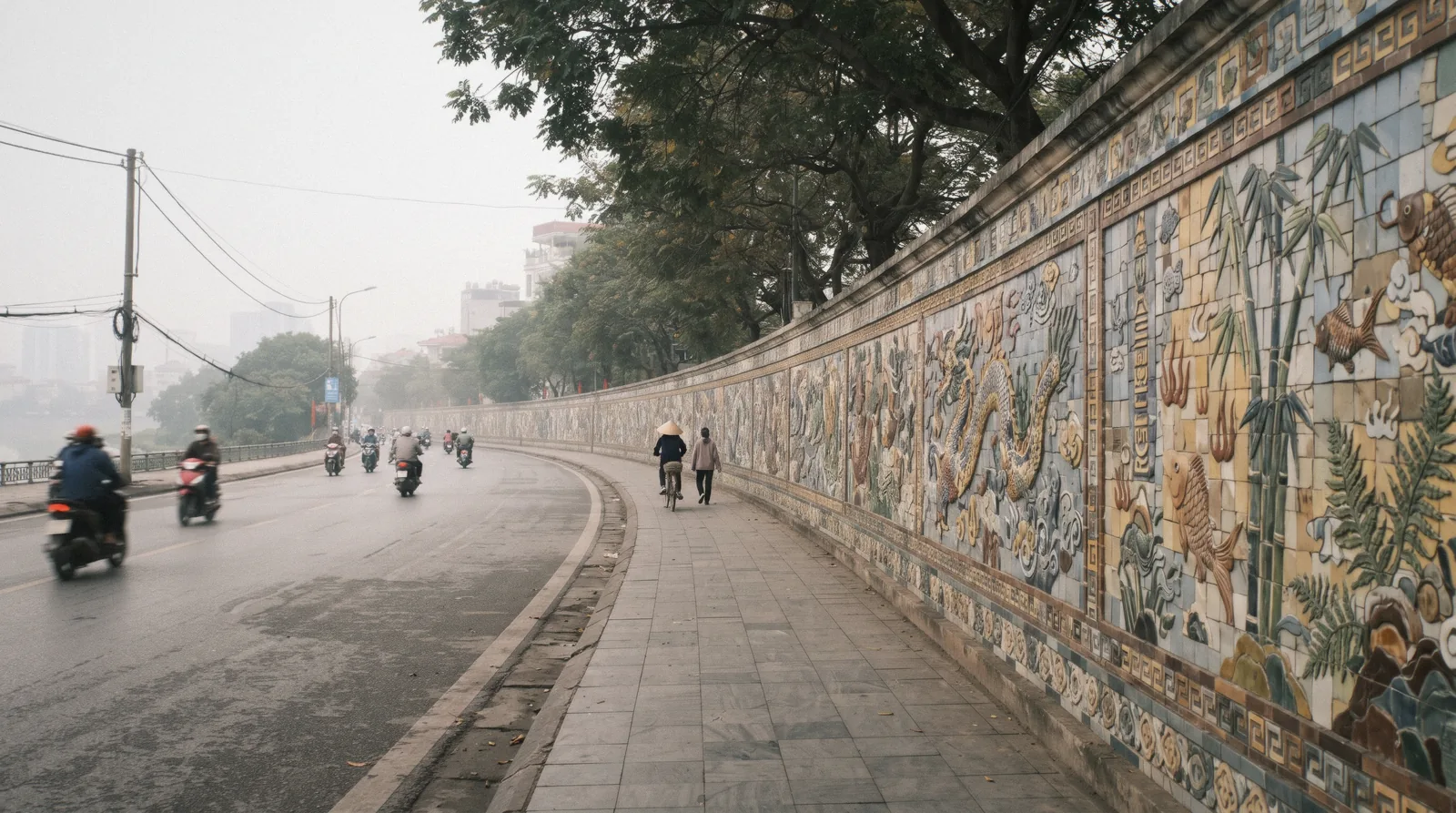
Hanoi Ceramic Mosaic Mural
The Hanoi Ceramic Mosaic Mural (Con đường gốm sứ, the Ceramic Road) is a wall of hand-laid ceramic tiles along the Red River dyke, built for the 1,000th anniversary of Thang Long-Hanoi and recognised as the world's largest ceramic mosaic. This page covers how long it is, who made it, the 600 metres removed in 2020 that most photos still show, where to walk the part that remains, what it costs to see, and which tours stop here. It is a free, short stop that pairs with the Long Bien Bridge, so it belongs among the things to do in Hanoi for anyone who likes street art. The Hanoi tours page lists the motorbike, jeep and photo routes that include it.
Quick answer Length, cost, the 2020 removal and how to see it, in four lines
The Hanoi Ceramic Mosaic Mural is a free wall of ceramic tiles along the Red River dyke, reported at 3,950 m long with 21 sections when it was finished in 2010. About 600 m of it along Au Co Street in Tay Ho was slated for removal in 2020 for an overpass project, and no rebuilding was confirmed, so walk what is there, not the 4 km on old photos. The easiest way to see it is a motorbike or photo tour, since one half-day motorbike ride stops at it.
Key takeaways
- It costs nothing and has no hours, so the cost section is about timing and traffic, not tickets.
- The 2020 removal section explains why older guides overstate the length.
- Pair it with the Long Bien Bridge, which is about 1.4 km east by map position.
- If you want to buy ceramics, Bat Trang Ceramic Village is where the craft is made and sold.
Key Facts
Opening Hours
| Any time, a public road | 00:00–23:59 |
|---|
Closed None. It is a wall on a public road. Works on the dyke have removed some sections
Admission
- Adult
- Free. No ticket exists in any source
- Reduced
- Not applicable
- Free
- Everyone
Planning It
- Time needed
- No official figure. Our estimate: 20 to 30 minutes for a stop, 1 to 2 hours to walk a long section
- Address
- Along the Red River dyke in Hanoi, including Au Co Street in Tay Ho district
Hanoi Ceramic Mosaic Mural Tickets and Tours
The wall is free to see, so the table starts with that and then lists the two tours that name it. Tour prices are platform listings in USD, and neither tour is a ticket for the wall.
Go on your own if the wall and the bridge are your plan. Take a tour if you want a guide and the rest of the loop.
| Option | Price | What it opens | Cancel | Book |
|---|---|---|---|---|
| Walk along the wallAnyone with a taxi, a bike or a pair of walking shoes | Free | The wall on the Red River dyke, at any time. No ticket or hours are listed in any source | Not applicable | Official site |
| Most popular motorbike tourRiders who want the wall as one stop on a city loop | $29 | A 3.5 to 4 hour guided ride with the Opera House, the Ceramic Mosaic Road, Long Bien Bridge, Banana Island and West Lake. Entrance fees included | Free up to 24 hours before | Check Availability |
| Instagram photo tourCouples and photographers who want a small private route | $32.83 | A 4-hour photo tour for no more than 2 guests that lists Ceramic Mosaic Street with Train Street and Long Bien Bridge | Free up to 24 hours before | Check Availability |
The wall costs nothing, so a tour pays for the ride and the other stops, not for entry.
Tours That Stop at the Ceramic Mosaic Wall
The wall is free to visit alone, so a tour is for the ride and the other stops. Two listings name it. Prices are the platform's USD listings, and the operator confirms the final amount at checkout.
 from $29
Hanoi Motorbike Tour: Most Popular Experience
Four-hour guided motorbike ride with hotel pickup, local meal and egg coffee. Entrance fees included.
Check Availability from $32.83
Hanoi Instagram Tour: The Most Scenic Spots
4-hour Hanoi photo tour for a maximum of 2 guests by car or motorbike, with Train Street and Long Bien Bridge.
Check AvailabilityPrices, ratings and details are the platform's own. Dollar figures are the listed prices. The platform bills in your account's currency.
What Is the Hanoi Ceramic Mosaic Mural?
A long wall of ceramic tile art on the Red River dyke, built for Hanoi's 1,000th birthday.
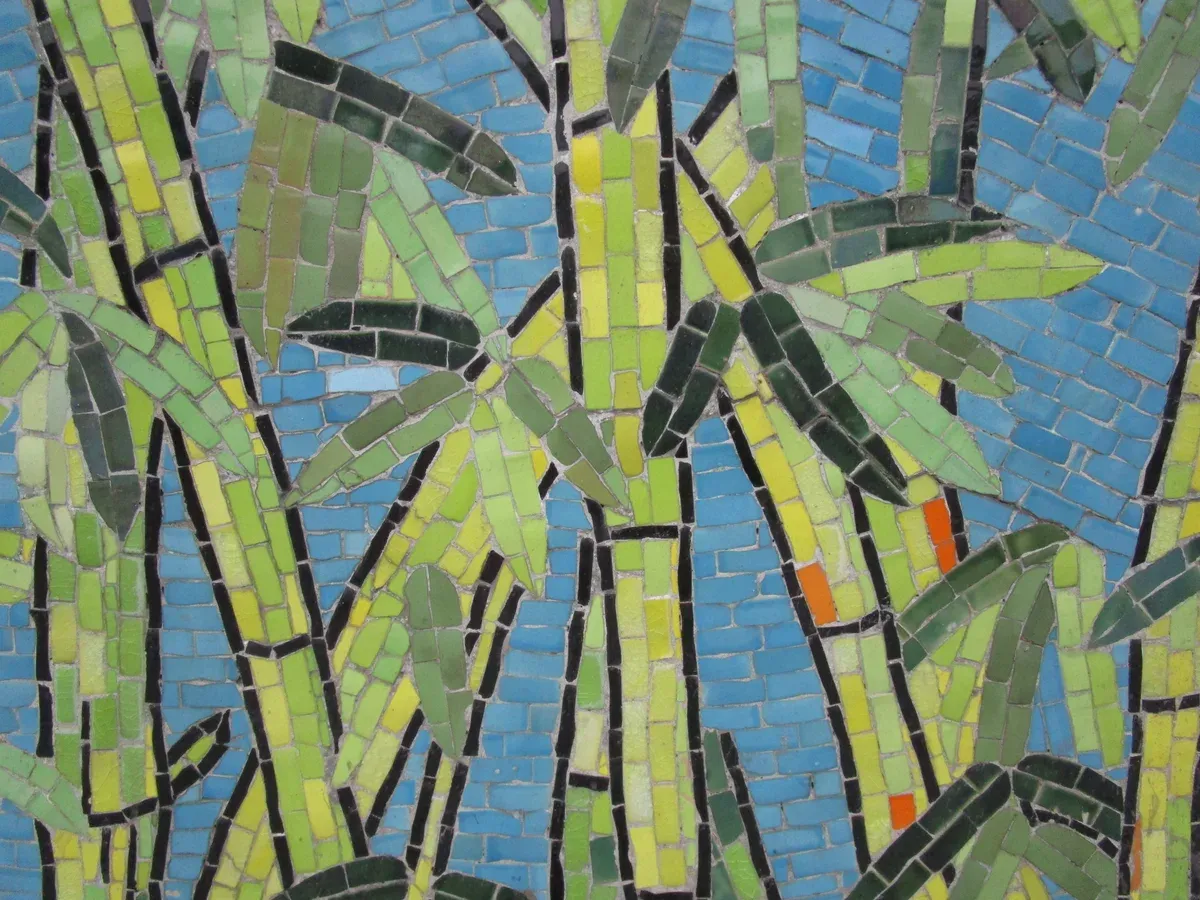
A bamboo panel on the wall. Photo: Diggers2004, CC BY-SA 4.0, via Wikimedia Commons
The Hanoi Ceramic Mosaic Mural is a wall of hand-laid ceramic mosaic along the Red River dyke, built from 2008 as one of the projects for the 1,000th anniversary of Thang Long-Hanoi in 2010. The government's Hanoi Capital portal called it the longest pottery mural in the world when it reported the work on 10 September 2010, at 3,950 metres and 21 sections, with completion set for 25 September that year. The project was started by the journalist and painter Nguyen Thu Thuy, and the portal says foreign artists made the biggest contribution. Dan Tri later wrote that Guinness World Records recognised it as the world's largest ceramic mosaic.
The subject matter is Vietnam's history and culture. The portal names the pottery villages whose ceramics are in it: Bat Trang, Phu Lang, Chu Dau, Binh Duong, Vinh Long and Bau Truc. Some sections are by companies and individual artists, such as a work for the International Labour Organization and a set based on Bui Xuan Phai's Old Quarter paintings. The wall is a continuous public artwork, not a museum, so it has no entrance and no labels you must queue for.
Source: Hanoi Capital, Government of Vietnam, Dan Tri International.
Is the Whole Hanoi Ceramic Mosaic Mural Still There?
No. About 600 metres along Au Co Street were removed from 2020, and rebuilding was not confirmed.
No. Dan Tri reported in June 2020 that 600 metres of the mural along Au Co Street in Tay Ho district would be removed for the second phase of the An Duong to Thanh Nien overpass project. The works were meant to ease traffic, improve the scenery and strengthen the dyke against flooding. The removed parts included the Bui Xuan Phai Old Quarter paintings and the work for the International Labour Organization. The artist behind the mural said she hoped the authorities would pay to restore it after construction, and no rebuilding was confirmed in that report.
The consequence for a visitor is plain. The 3,950 m figure belongs to 2010. Many guides and photos still describe a continuous 4 km wall, and they are older than the removal. Check a recent map or ask your guide which stretch is intact before you plan a long walk, and expect gaps, repairs and works fences. The sections that remain are still worth a stop.
Source: Dan Tri International.
How Much Does the Hanoi Ceramic Mosaic Mural Cost and When Is It Open?
Nothing and always, because it is a wall on a public road.
It is free, and no source lists a ticket or opening hours. The wall stands beside the dyke road, so you can reach it at any time of day. The practical limits are traffic and weather, not a gate. Motorbikes use the road beside the pavement, so stand on the pavement side of the wall, and take photographs early or late when the light is soft and the dyke is quieter. Bring water if you plan a long walk.
If you pay for anything it is the ride. A motorbike or jeep tour that includes the wall bundles it with the Long Bien Bridge, Banana Island and a lunch, and the Hanoi taxi fare tool gives the metered cost of a taxi there and back.
| Question | Answer |
|---|---|
| Entry fee | None. A wall on a public road |
| Opening hours | None listed. Open to walk at any time |
| Length reported in 2010 | 3,950 m in 21 sections |
| Removed from 2020 | About 600 m on Au Co Street |
| Nearest big sight | Long Bien Bridge, about 1.4 km east |
Source: Hanoi Capital, Government of Vietnam, Dan Tri International.
Where Is the Hanoi Ceramic Mosaic Mural and How Do You See It?
Along the Red River dyke north of Long Bien Bridge, on foot, by bike or on a tour.
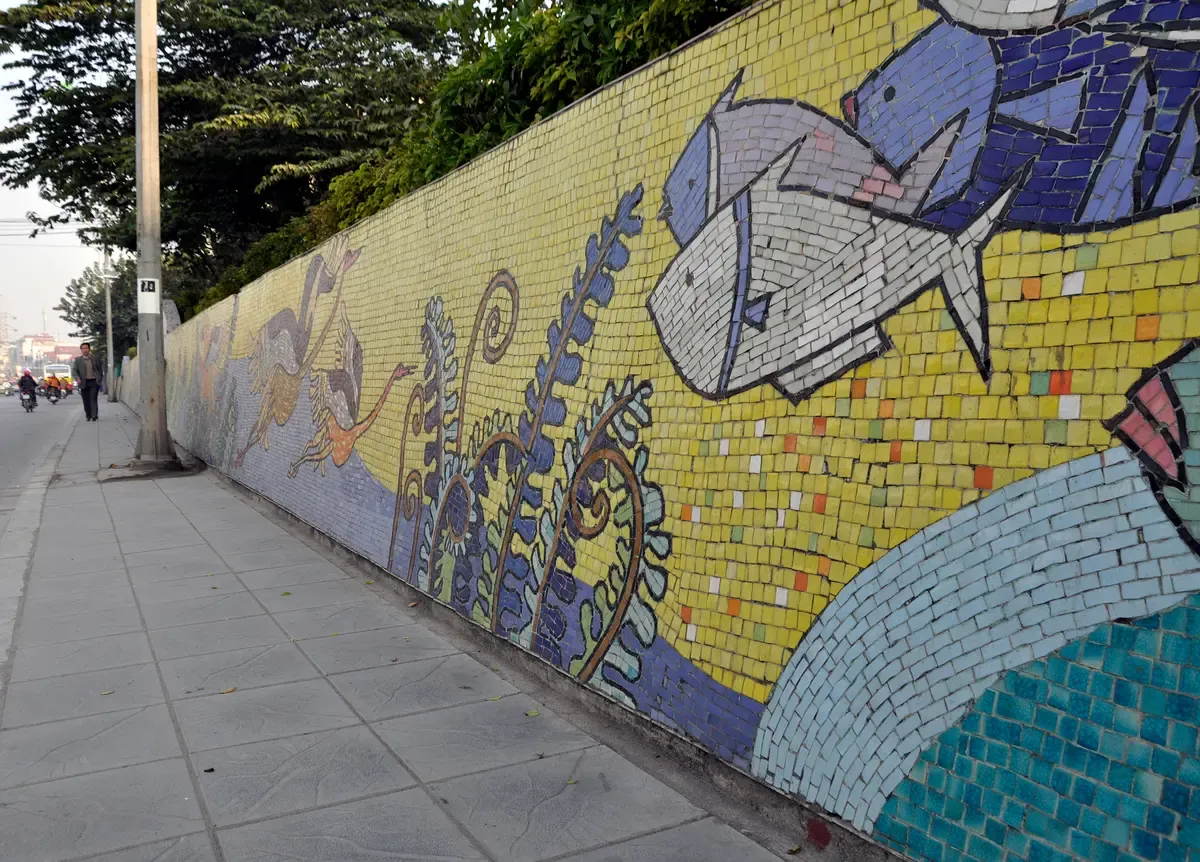
A stretch of the wall beside the pavement. Photo: P. Hughes, CC BY 4.0, via Wikimedia Commons
The mural runs along the Red River dyke, and the point most maps mark is about 1.4 km west of the Long Bien Bridge. The Au Co Street stretch, where the 2020 removal happened, is part of the dyke in Tay Ho district. The wall has no single entrance, so the best approach is to pick a stretch on a map and walk it, or to ride along it.
There are three ways. First, a taxi or ride-hailing car to the marked point, then a walk along the pavement. Second, a bicycle or motorbike, which lets you cover a long run of wall and keep going to the Long Bien Bridge. Third, a tour: the half-day motorbike ride lists the Ceramic Mosaic Road after the Opera House and before Banana Island, and the photo tour lists Ceramic Mosaic Street between Train Street and the Banana Farm. Both are in the tour table above. If you have a bike, the wall makes a good first stop before the bridge.
Is the Hanoi Ceramic Mosaic Mural Worth Visiting?
Yes as a short, free stop, and not as a destination on its own.
It is worth 20 to 30 minutes if you are already near the Long Bien Bridge or on a motorbike, jeep or photo tour. It is free, colourful and easy to photograph, and the scale is unusual for a street artwork. It is not worth a long trip on its own, because the removed stretch has shortened the continuous run. If you have one hour for street art, combine the wall with the bridge, and if you have an hour for ceramics, go to Bat Trang Ceramic Village.
Source: Dan Tri International.
Where Can You Buy Ceramics in Hanoi?
In Bat Trang village, where the craft is made.
The mural is art on a wall, not a place that sells pottery. For ceramics to take home, go to Bat Trang Ceramic Village, the pottery village on the other side of the Red River, where the tours that include a pottery class are listed. The village is also one of the pottery villages named in the mural itself, so the two make a natural pair: see the wall first, then the craft.
The Vietnam National Museum of Fine Arts holds historic ceramics if you want the older tradition.
Source: Hanoi Capital, Government of Vietnam.
How Long Do You Need at the Ceramic Mosaic Mural?
About 20 to 30 minutes for a stop.
Allow 20 to 30 minutes for a stop and one to two hours if you want to walk a long section. No source gives a visit time, so this is our estimate. On a motorbike tour it is usually a short photo stop, since the route continues to the bridge. A good half-day order is the wall in the morning, the Long Bien Bridge, then a coffee in the Old Quarter.
If you walk, stay on the pavement side.
Source: Hanoi Capital, Government of Vietnam.
Hanoi Ceramic Mosaic Mural Map: The Wall and the Long Bien Bridge
One point on the wall and the sights nearby. The wall runs along the dyke for kilometres, so the pin marks one stretch only. Pin positions are approximate.
Pin positions come from Wikipedia and Wikidata, within about 200 metres.
Tips for Visiting the Hanoi Ceramic Mosaic Mural
The short list for the day you go.
Do
- Check a recent map for the stretch you want, since 600 m were removed
- Walk on the pavement side of the wall
- Go early or late for softer light and quieter traffic
- Bring water if you plan a long walk
- Combine it with the Long Bien Bridge
Don't
- Do not plan a continuous 4 km walk from an old guide
- Do not stop on the carriageway for a photo
- Do not climb or lean on the tile wall
- Do not expect a ticket office, signs or opening hours
- Do not confuse it with the Phung Hung mural street, a different wall in the Old Quarter
What Is Near the Hanoi Ceramic Mosaic Mural?
The wall sits on the northern dyke between the bridge and West Lake. Walking times are our estimates from map positions.
Long Bien Bridge
The old Red River bridge, usually the next stop after the wall.
About 1.4 km east, our estimateTran Quoc Pagoda
The pagoda on West Lake, a quiet stop after the dyke.
About 1 km west, our estimateHanoi Old Quarter
Coffee and street food after the wall.
A short ride south, our estimateHanoi Ceramic Mosaic Mural FAQ
How Long Is the Hanoi Ceramic Mosaic Mural?
It was reported at 3,950 m with 21 sections in 2010. About 600 m along Au Co Street were slated for removal in 2020, so the intact length is shorter now. The removal section explains.
How Much Does It Cost to See the Hanoi Ceramic Mosaic Mural?
Nothing. It is a wall on a public road with no ticket and no opening hours.
Where Is the Hanoi Ceramic Mosaic Mural?
Along the Red River dyke in Hanoi, including Au Co Street in Tay Ho district. The point most maps mark is about 1.4 km west of Long Bien Bridge.
Who Made the Hanoi Ceramic Mosaic Mural?
The project was started by the journalist and painter Nguyen Thu Thuy and built from 2008 with many artists, including foreign artists, for the 1,000th anniversary of Thang Long-Hanoi.
Was Part of the Mural Destroyed?
About 600 m along Au Co Street were slated for removal in 2020 for an overpass project, and no rebuilding was confirmed in the report.
Where Is the Best Place to Buy Pottery in Hanoi?
Bat Trang Ceramic Village, where the craft is made. The Bat Trang guide lists the tours that include a pottery class.
Is the Hanoi Ceramic Mosaic Mural Worth a Visit?
Yes as a 20 to 30 minute free stop with the Long Bien Bridge. The worth-it section says when to skip it.
Hanoi Ceramic Mosaic Mural Videos
Three videos show the wall before you go.
Hanoi Ceramic Mosaic Mural - the Longest Ever in the World (4 Kilometers)
An early film of the finished wall.
Video: vninsightHanoi Ceramic Mosaic Wall | Walking Along the Giant Mosaic Mural
A walk along a stretch of the wall.
Video: Roaming with MartinSolo Traveling on Ceramic Mosaic Mural Road, Hanoi, Vietnam
A solo visit to the Ceramic Road.
Video: SOLO BACKPACKER

Prices, hours and terms are set by the venue or operator and confirmed at checkout.
We may earn a commission if you book through one of our links, at no extra cost to you. Full affiliate disclosure